

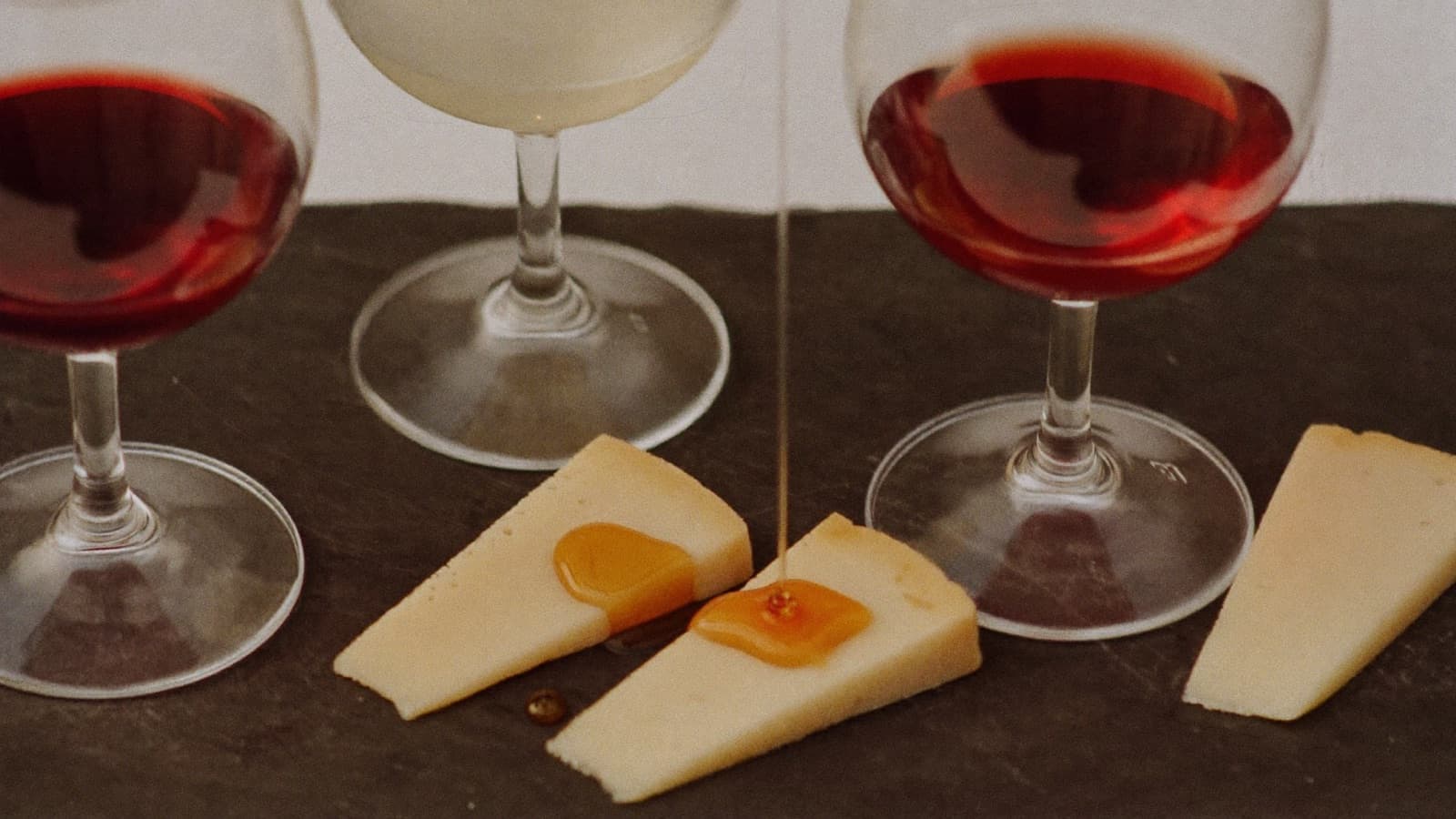
Wine and cheese is the pairing everyone reaches for without thinking. House party, picnic, first date, Tuesday — out comes a bottle and a wedge, and nobody questions it.
But here's a question worth asking: why? Why does this particular combination work so reliably when so many food-and-wine matches are a gamble? And while we're at it — is the reflex to grab a big red with any cheese actually right?
Spoiler: it's often wrong. The good news is that the real logic is simple, and once you have it, you'll pair wine and cheese better than most restaurants.
The Real Reason They Work
Wine and cheese aren't just culturally glued together. They're chemically built to complete each other.
Think about what cheese is: fat, salt, and protein. Now think about what wine brings: acid, tannin, sometimes sweetness, and alcohol. Put them together and four things happen, all of them good:
Acid cuts fat. Cheese coats your mouth in rich, fatty residue. Wine's acidity slices straight through it and resets your palate, so the next bite tastes as good as the first. This is why crisp, high-acid wines are such reliable cheese partners — they refresh where the cheese saturates.
Salt softens wine. Salt is a flavor magic trick. It tames bitterness and the drying grip of tannin, and it makes fruit taste riper and sweeter. A young, slightly harsh red can taste rounder and friendlier the moment salty cheese hits your tongue.
Protein and fat tame tannin. This is the same mechanism that makes red wine and steak inseparable: the protein and fat in the cheese bind to tannin molecules, so a grippy red feels smoother and plusher alongside an aged hard cheese. The wine stops fighting you and starts flattering you.
Each makes the other taste better. That's the whole point. The cheese softens and sweetens the wine; the wine refreshes the palate and lifts the cheese. It's one of the few food-and-drink combinations that's genuinely mutual — neither one is just a backdrop for the other.
The Myth: "Red Wine Goes With Any Cheese"
Now the part that surprises people. The instinct to pour a big red with a cheese board is, more often than not, a mistake.
Tannic reds (Cabernet, Syrah, young Bordeaux) clash with a lot of cheese — especially soft, creamy, and pungent ones. The tannin collides with the fat and the funk and can turn metallic, bitter, or harsh. You've probably felt it without naming it: that slightly chalky, sour note when a bold red meets a ripe Brie.
The truth the wine world is weirdly quiet about: white and sparkling wines are usually better cheese partners than red. High acidity, low or no tannin, and a clean finish make them flatter almost everything on the board. If you could only bring one wine to a cheese spread, you'd be smarter to bring a crisp white or a sparkling wine than a heavy red.
Red still has its moments — they're just more specific than people assume. We'll get to exactly when.
Match by Cheese Type
You don't pair wine to "cheese." You pair it to a kind of cheese. Here's the practical map, soft to hard.
Fresh & Soft (mozzarella, burrata, ricotta, chèvre)
Bright, milky, often tangy. They want crisp, high-acid whites, sparkling, or dry rosé. The all-time classic: fresh goat cheese (chèvre, SHEV-ruh) with Sauvignon Blanc — specifically Sancerre (sahn-SAIR) from the Loire, where the same chalky soil grows the grapes and feeds the goats. "What grows together goes together" is a real rule, and this is its poster child.
Bloomy & Creamy (Brie, Camembert)
Rich, buttery, a little mushroomy. The hero here is bubbles. Champagne and other sparkling wines use acidity and effervescence to scrub the cream off your palate — the single most satisfying cheese pairing there is. A light, low-tannin red like Pinot Noir or an unoaked Chardonnay also works.
Semi-Hard (Gruyère, Comté, Manchego, cheddar)
The versatile middle. Nutty and firm, they handle the widest range — medium-bodied reds, nutty whites, even a dry Sherry. Aged cheddar is one of the few cheeses that genuinely loves a Cabernet. Manchego with a glass of Spanish Sherry or Rioja is a regional match made on purpose.
Hard & Aged (Parmigiano-Reggiano, aged Gouda, aged Manchego)
This is where red wine finally earns the spotlight. Aged hard cheeses are concentrated, salty, and often dotted with those little crunchy crystals — and all that intensity and protein stands up to tannin instead of buckling under it. Parmigiano-Reggiano with a Sangiovese (Chianti) or a Barolo is sublime. Aged Gouda with a robust Cabernet is dangerously good. Big red + big aged cheese is the pairing the "red goes with everything" crowd is half-remembering.
Blue (Roquefort, Stilton, Gorgonzola)
The most counterintuitive pairing in all of wine, and the most reliable: blue cheese wants sweet wine. The salt and funk of a blue against the honeyed richness of a dessert wine is pure fireworks. The textbook duos — Roquefort with Sauternes (soh-TAIRN), Stilton with Port — have survived for centuries because nothing else comes close. Sweet against salty-pungent is the move. Trust it.
Washed-Rind & Stinky (Époisses, Taleggio, Munster)
The cheeses that announce themselves from across the room. They want aromatic whites with a touch of sweetness to stand up to the funk — Gewürztraminer (guh-VOORTS-trah-mee-ner) or off-dry Riesling. The Alsatian classic of pungent Munster with Gewürztraminer is the regional rule doing its thing again. Tannic reds? They don't stand a chance here. Orange wine, with its grip and savory edge, is a fun wildcard for this category too.
The Classics, in One Glance
When you don't want to think, copy the people who've been doing this for a few hundred years:
| Cheese | Pour This | Why |
|---|---|---|
| Goat cheese (chèvre) | Sauvignon Blanc / Sancerre | Acid + tang, same terroir |
| Brie / Camembert | Champagne or sparkling | Bubbles cut the cream |
| Aged Parmigiano | Chianti / Sangiovese | Salt + crystals tame tannin |
| Aged Gouda / cheddar | Cabernet Sauvignon | Intensity matches intensity |
| Manchego | Sherry / Rioja | Spanish regional match |
| Roquefort (blue) | Sauternes | Sweet vs. salty-pungent |
| Stilton (blue) | Port | The dessert-course legend |
| Munster (washed-rind) | Gewürztraminer | Aromatics vs. funk |
How to Build a Board That Actually Works
Two strategies, depending on the night.
The one-bottle move. If you're putting out a range of cheeses and pouring a single wine, pick the universal donor: a sparkling wine, a dry rosé, or an off-dry Riesling. High acidity, food-friendly, low or no tannin — these flatter the most cheeses with the fewest casualties. This is the "I'm not overthinking it" answer, and it's a good one.
The star-pairing move. Pick one show-stopping cheese and pour its perfect partner — Stilton and Port, or Brie and Champagne — and let that be the moment. One great match beats five mediocre ones.
A couple of mechanics that quietly matter: serve cheese at room temperature (cold mutes both flavor and aroma — pull it out 30–60 minutes ahead), and arrange the board mild-to-strong so the pungent stuff doesn't steamroll the delicate stuff. Same logic applies to the wines: lighter and crisper first, richer and sweeter last.
A Word on Doing This Shamelessly
Somewhere along the way, culture decided wine and cheese were a guilty indulgence — something to track, apologize for, and offset with a kale smoothie. We reject this entirely, and so does our sister site.
The Wine & Cheese Diet is exactly what it sounds like: a gloriously tongue-in-cheek takedown of diet culture that treats wine and cheese not as a cheat day but as the actual plan. Its motto — "Clinically unverified. Culturally inevitable." — tells you everything about the spirit of the place. If your ideal wellness regimen involves "no macro tracking, no before photos, several excellent dinners," it's worth a visit. Consider it the philosophy degree to this article's how-to.
The Bottom Line
Wine and cheese work because they're chemical opposites that complete each other: fat and salt and protein on one side, acid and tannin and sweetness on the other. Once you know that, the rules write themselves.
When in doubt, remember three things:
- Reach for acid. A crisp white or sparkling wine pairs with more cheese than any red.
- Match intensity. Delicate cheese, delicate wine. Big aged cheese, big wine.
- Sweet loves blue. It's the one pairing that sounds wrong and tastes perfect.
Then stop optimizing and start eating. That's the part the chemistry can't teach you, and it's the only part that really matters.