

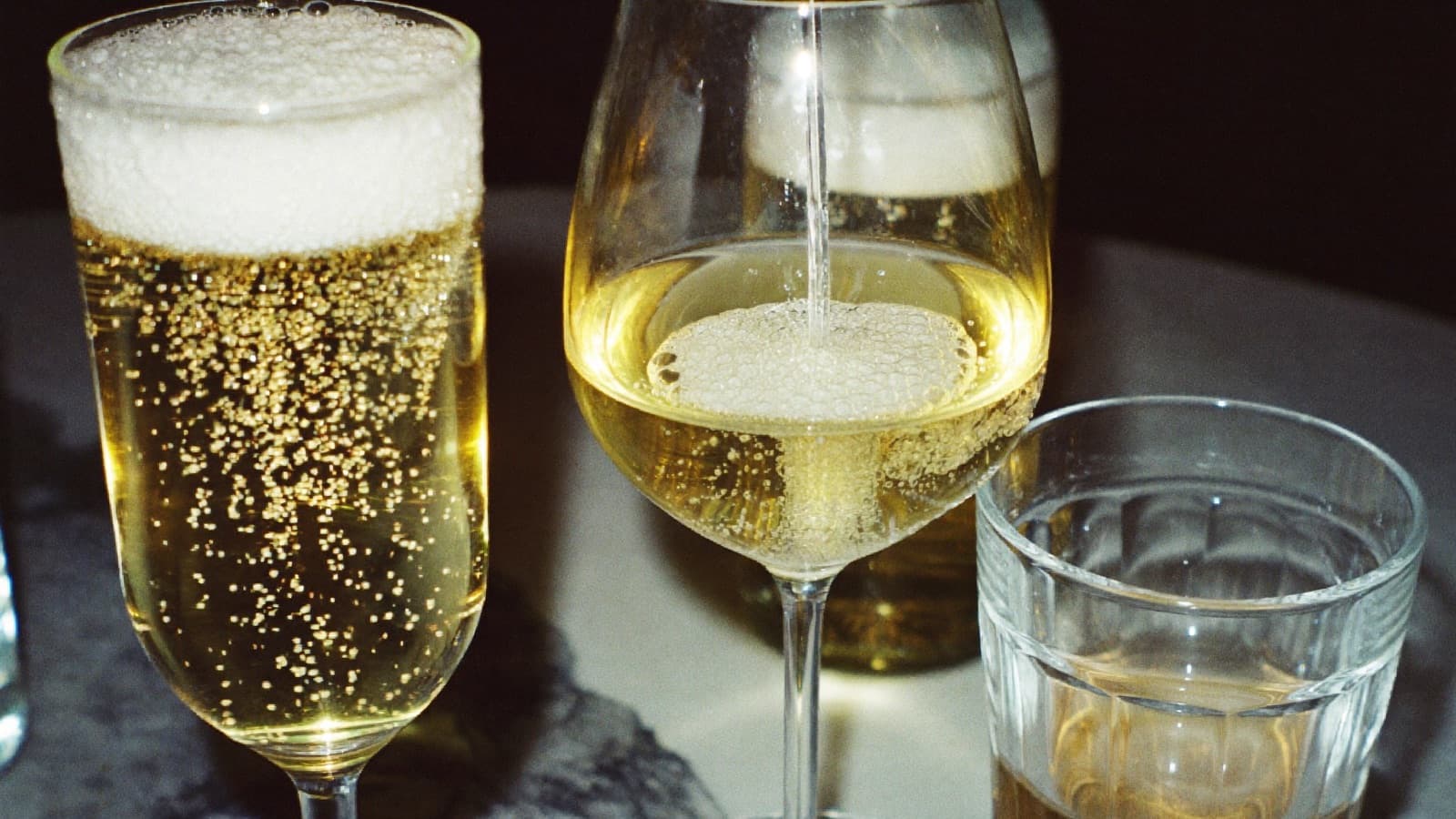
Let's establish something quickly: Champagne is one of the greatest wines on earth. It is also wildly overpriced for regular drinking, dominates the sparkling category by reputation alone, and has convinced an entire planet to treat every other bubble as a consolation prize.
This is wrong, and expensive, and it's time to fix it.
The world is full of extraordinary sparkling wine made by the exact same method as Champagne, from equally serious producers, for a fraction of the price. The people who know this are having a better time than you are at the wine list. Here's the whole picture.
How Champagne Works (and Why It's a Template)
The reason Champagne tastes the way it does — toasty, complex, nutty, with persistent fine bubbles — comes down to a production method called méthode champenoise, or traditional method.
The short version: wine is fermented, then bottled with a small dose of sugar and yeast. Those yeast eat the sugar and produce CO2, which is trapped in the bottle as bubbles. The wine ages on the dead yeast cells (called lees) for months or years, developing that distinctive bready, toasty complexity. The dead yeast are then removed through a complicated process involving frozen necks and skilled disgorgers.
This process works anywhere in the world with the right grapes. It doesn't require Champagne, France. It requires patience and technique. Many, many winemakers outside Champagne have both.
The Category Map
Cava — Spain's Brilliant Open Secret
Cava is traditional-method sparkling wine from Spain, mostly from Catalonia. Made from indigenous grapes — Macabeu, Xarel-lo, Parellada — it undergoes the same second fermentation in bottle as Champagne.
The result is nutty, crisp, with good bubble structure and an earthy, slightly rustic character that works brilliantly with food. The best Cavas at the Reserva and Gran Reserva levels (minimum 15 and 30 months on lees, respectively) get genuinely complex in a way that would cost twice the price with a Champagne label.
What to spend: $12–$20/bottle for excellent everyday Cava. $25–$45 for Gran Reserva expressions that drink like $80 Champagne.
Producers to know: Gramona, Recaredo, Raventós i Blanc, Juvé & Camps, and the widely available Freixenet and Codorníu for everyday.
When to order it: Always. But especially when someone orders a round of Champagne and you'd rather spend the difference on a second bottle.
Crémant — Champagne's Neighbor, Without the Premium
Crémant is the catch-all designation for traditional-method sparkling wine made in French regions outside Champagne. You'll see:
- Crémant d'Alsace — Pinot Blanc and Auxerrois, delicate, floral, very dry
- Crémant de Bourgogne — Chardonnay and Pinot Noir, the most Champagne-adjacent, often extraordinary
- Crémant de Loire — Chenin Blanc based, lighter and slightly more austere
- Crémant du Jura — for the adventurous; made from Chardonnay and local grapes, has a savory, almost nutty quality that's unlike anything else
Crémant de Bourgogne is the strongest Champagne competitor in the $18–$30 range. Same grapes, same method, different appellation name, dramatically different price.
The pitch: "It's basically Champagne but the producer doesn't pay for the name on the label. The wine is indistinguishable to 90% of drinkers."
Producers to know: Louis Bouillot, Bailly Lapierre, Albert Sounit, Vitteaut-Alberti.
Prosecco — When the Occasion Calls for Easy and Delicious
Let's be honest about Prosecco: it is not made by the traditional method. It uses the Charmat or tank method — secondary fermentation happens in large pressurized tanks rather than individual bottles. This produces bigger, softer bubbles and a fresher, more fruit-forward character.
Prosecco is not trying to be Champagne. It succeeds brilliantly at being Prosecco: light, easy, slightly floral, with green apple and white peach flavors that make it endlessly approachable. It is correct on a Sunday afternoon. It is correct with aperitivo. It is correct whenever you want bubbles without occasion pressure.
What to spend: $12–$18/bottle. Anything over $25 is telling you a story.
Look for: DOCG (Conegliano Valdobbiadene) on the label — higher quality standard than basic DOC. Brut or Extra Brut for drier styles.
Producers to know: Bisol, Ruggeri, Adami, Bortolomiol.
Pét-Nat — The Oldest Bubble, the Weirdest Menu Option
Pét-Nat (short for pétillant naturel) is wine finished with a method called méthode ancestrale — the oldest sparkling wine technique, predating Champagne by centuries. The wine is bottled before fermentation is completely finished, so the natural CO2 from fermentation creates bubbles in the bottle.
The result is less effervescent than Champagne — lower pressure, softer bubbles, sometimes slightly cloudy because the sediment isn't removed. Flavors are wilder and less polished: more fermented, more honest, sometimes a little funky in a way that either delights or confuses.
If you see Pét-Nat on a restaurant list and they clearly know what they're doing with wine, order it. It is a very specific experience — like the rough draft of Champagne, the version before anyone sanitized it — and it pairs brilliantly with natural, vegetable-forward cooking.
What to spend: $14–$25/bottle is the typical range.
Look for: Pét-Nat from the Loire Valley (France), Emilia-Romagna (Italy), and an increasingly strong American Pét-Nat scene from producers in California, Oregon, and New York.
The Actual Recommendation
For a regular Wednesday dinner: Cava. Open a Gran Reserva from Gramona or Recaredo. It is $20–$30 and is better than a $55 Champagne with your food.
For a special occasion where Champagne seems right but you don't want to spend $90: Crémant de Bourgogne from Louis Bouillot. Order it without explanation. Let people guess. When they ask what it is, tell them.
For the first date or the birthday dinner: actual Champagne, a house pour by the glass, no apology needed. Some occasions have a designated wine and Champagne earns its moments.
For the natural wine bar with the interesting list: whatever Pét-Nat the sommelier is excited about. Ask them about it. Let the story be part of the drink.
The One Number to Remember
A traditional-method sparkling wine from Champagne averages $55–$65 retail for a non-vintage bottle. A traditional-method sparkling wine from Burgundy (Crémant de Bourgogne) averages $18–$28 for an equivalent style. The delta is almost entirely label.
You now know this. Use it.