

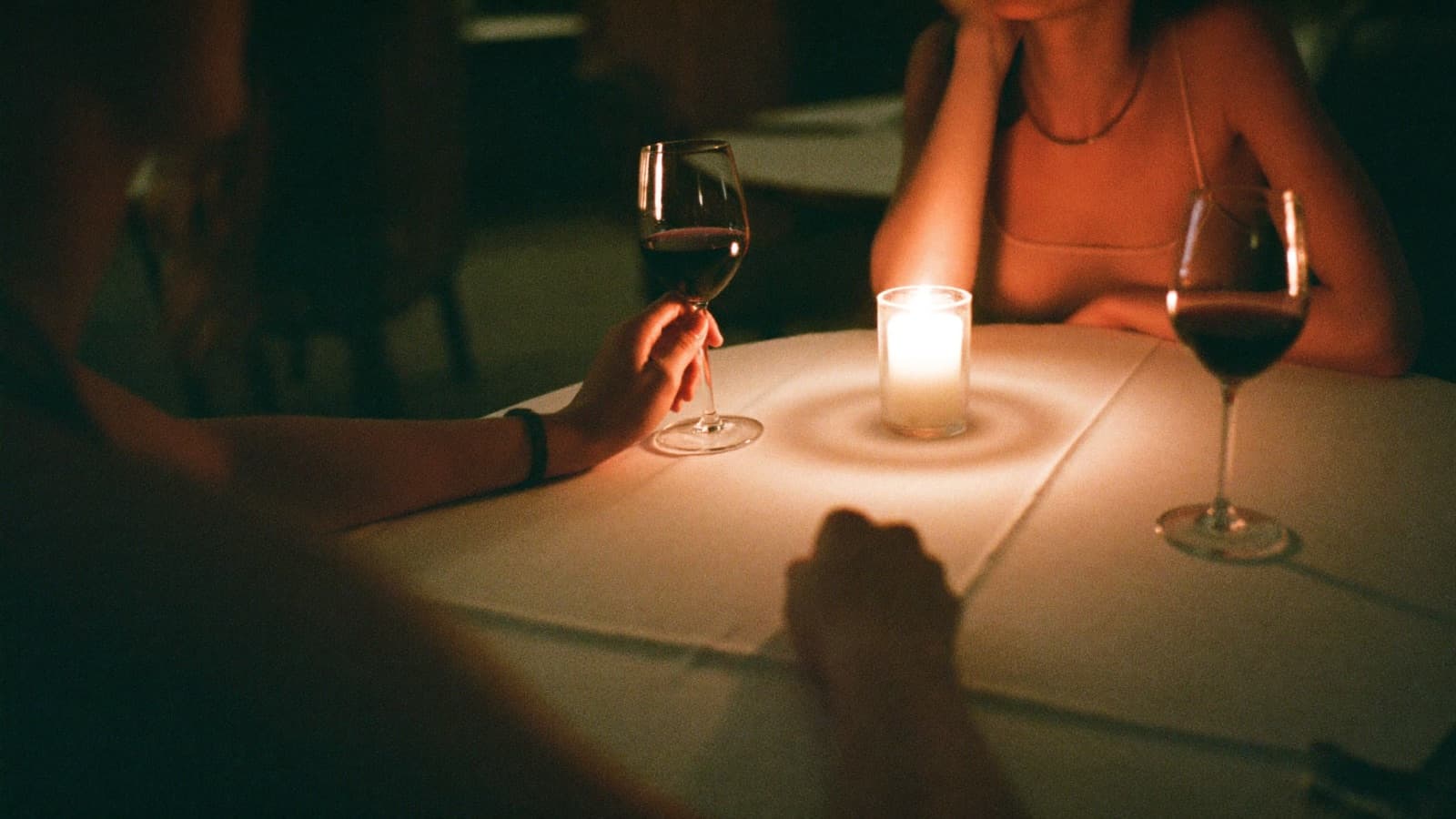
You are being evaluated. You know this. They know this. Everyone at the restaurant knows this.
The server especially knows this, because they've seen it nine times tonight and they have a theory about how it ends.
The wine order is a small but genuine window into your personality. Not because what you drink reveals deep character — it doesn't, really — but because how you order reveals whether you're comfortable, curious, considerate, and capable of making a decision. These are not small things on a first date.
Here is the complete guide.
The Basic Framework
Before we get tactical, here's the principle: order wine that creates conversation, not wine that ends it.
The best first-date wine order is one where you either (a) ask a question about what they'd like and genuinely listen, (b) make a confident recommendation that invites their input, or (c) both. What you are trying to avoid is (d) a 4-minute internal deliberation while they watch.
Confidence is more attractive than expertise. A confident "I was thinking we start with a glass of something sparkling while we look at the menu — does that sound good?" is better than a technically brilliant wine selection delivered while you mutter at the list for three minutes.
What to Order: The Smart Moves
Start with bubbles. This is almost always correct. It signals celebration without trying too hard, it's easy to drink immediately without needing to breathe or reach serving temperature, and it pairs with everything on the first-drink-before-food stage of the evening. Cava or Crémant is $12–16/glass at a good restaurant and is indistinguishable from Champagne to most people. Actual Champagne by the glass runs $18–28 and is appropriate if the place calls for it.
The reason bubbles work: they say "this is a good occasion" without saying "I researched this date for three days."
A glass each before committing to a bottle. Unless you already know you both drink and want roughly similar things, starting with individual glasses lets you calibrate without commitment. There is nothing wrong with two different glasses at a table for two. In fact, it's a conversation: "What did you order? Can I try it?"
Ask what they like first. This is both good wine strategy and good date strategy. "Are you more of a red or white person?" or "Is there anything you don't love?" gives you actual useful information and demonstrates that you are interested in their preferences. Wild concept, widely underutilized.
The crowd-pleasing bottle if you're going that direction: A Pinot Noir from Oregon or Burgundy splits the difference between red-wine boldness and approachability. A white Burgundy (Chardonnay, but the elegant kind) works if either of you leans white. Rosé from Provence is a genuine crowd-pleaser and requires zero apology.
What to Avoid: The Quiet Mistakes
The second-cheapest bottle. The most obvious value-seeking move on any wine list. Your date may not consciously register it, but at some level they notice. If budget is genuinely a concern — completely fine, very normal — pick something in the middle range that you're ordering because it's good, not because it's the cheapest thing you're not embarrassed by.
The most expensive bottle. Unless you're at a place where that's reasonable and you legitimately want it, ordering an obviously expensive wine on a first date reads as performance. "Look at what I'm willing to spend" is not the message you're trying to send. The message you're trying to send is "I'm going to make this a good night." Those are different things.
Asking the sommelier to just pick something without any parameters. This puts all the agency with a third party and makes you look like you have no opinions. "We're thinking red, somewhere in this range, we're having the steak and the salmon" is a great brief. "Just bring us something" is not.
Lecturing about wine. If you know a lot about wine: congratulations, that's useful. Share one interesting thing if it comes up organically. Do not deliver a five-minute explanation of Burgundy's appellation system. Read the room. This is true even if the room seems interested.
Sending a wine back because you "don't love it." The tasting ritual is a quality check, not a test drive. If the wine is corked (wet cardboard smell) or genuinely flawed, absolutely send it back with a calm "I think this might be off." But if you ordered a tannic red and it's tannic, drink the red. Returning wine because you've changed your mind reads as difficult.
The Conversation Wine Creates
The best wine order on a first date is a conversation starter, not a closed topic.
"Have you ever had orange wine? There's one on here I've been curious about" — now you're exploring something together.
"The sommelier recommended this — she said it's from a small producer in the Rhône that they just started carrying. I have no idea if she's right but let's find out" — now there's a shared stakes narrative.
"I'm terrible at choosing wine. I just point at the middle price and hope for the best. Tell me what you'd pick if it were your call" — now they're involved and you've demonstrated self-awareness and the ability to hand over control.
Any of these is better than silently selecting the Malbec and handing the menu back without comment.
The Actual Recommendation
You want one answer, not a decision tree. Here it is:
Open with a glass of something sparkling — Cava, Crémant, or Champagne depending on the restaurant. Ask what direction they want to go for the meal. If you end up with a bottle, order a Willamette Valley Pinot Noir (approachable to red wine drinkers and non-red-wine drinkers alike) or a Sancerre or white Burgundy if you're going white.
Under no circumstances should you agonize publicly. Make a decision. If it's wrong, laugh about it. The ability to make a decision and be easy about it if things go sideways is more impressive than getting the wine right.
The wine is not the point. The night is the point.
The wine just helps.