

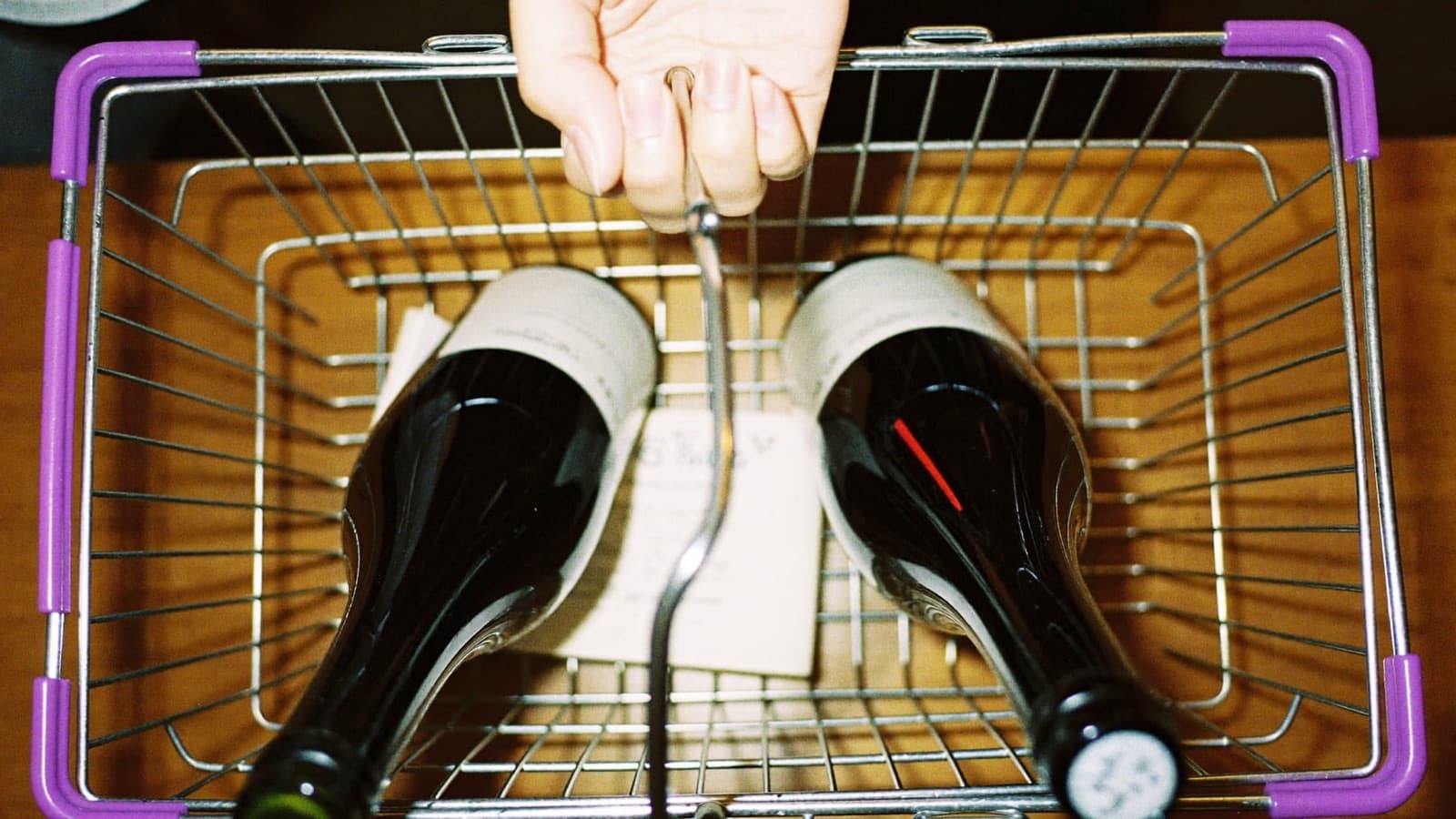
You are standing in the wine aisle. You have eight minutes before you need to be somewhere. There are 200 bottles in front of you. Someone shelved them in no particular order that helps you, and the shelf talkers all say "AWARD WINNING" or "SMOOTH & APPROACHABLE" which conveys approximately nothing.
This is a designed experience, and it's designed for the store's margins, not your enjoyment.
Here's the counter-program.
Why the Grocery Store Wine Aisle Is Confusing on Purpose
Wine is a high-margin product for grocery retailers. The labels that scream loudest — Barefoot, Josh, Meiomi, Menage à Trois — are marketing budget, not quality. These brands exist to be recognized in exactly the panicked moment you're currently in. The recognition is the product.
This doesn't mean they're terrible. It means you're paying primarily for distribution and branding. You can almost always do better for the same money or less, if you know where to look.
The 90-Second System
Step 1: Skip the bottom two shelves. The most profitable bottles for the store are at eye level and prominently displayed. The genuinely interesting stuff is often lower, more tucked, less promoted. This isn't a universal rule but it's a useful starting tilt.
Step 2: Look for regional specificity on the label. "California Red" or "American Pinot Noir" on the label means grapes from multiple regions blended for consistency. It's fine but you're paying for predictability. A label that says "Willamette Valley" or "Sonoma Coast" or "Côtes du Rhône" is telling you something specific. Specific usually means the producer cares about where the grapes come from.
Step 3: Find the $14–$22 range and stay in it. The wine quality curve gets steep above this range in a grocery store context — most stores don't have the cellar conditions to properly stock anything above $30. Below $12, you're in bulk-wine territory where the difference between bottles is almost nothing. The $14–$22 sweet spot is where regional producers and co-ops sell genuinely well-made wine at honest prices.
Step 4: Use the back label. The back label is written by the producer, not the retailer. Look for: a specific vintage year, a named region or appellation, and actual flavor descriptors (not marketing language). "Shows notes of dark cherry, dried herb, and a savory finish" tells you something. "Bold and juicy with food-friendly flavors" tells you nothing.
The Reliable Regions by Style
When you need a good bottle without time to research, buy from these regions and you are statistically likely to get more wine for your dollar than if you grab something you recognize from TV.
For red and you want something crowd-pleasing:
- Côtes du Rhône, France — Grenache-based blends, $12–$18, consistently excellent. Look for E. Guigal and Château Pesquié.
- Mencia from Bierzo, Spain — dark, earthy, specific, $16–$24, the kind of wine that makes people ask questions
- Nero d'Avola from Sicily — ripe, full, great with food, usually under $18
For red and you want something lighter:
- Beaujolais, France — specifically Beaujolais-Villages or a named cru (Morgon, Fleurie, Chiroubles), $14–$22, Gamay grape, absolutely delicious, criminally underordered
- Pinot Noir from Oregon — Willamette Valley on the label, $16–$24, reliable at most price points
For white:
- Vermentino from Sardinia or coastal Italy — bright, saline, herbal, great with food, $14–$20
- Grüner Veltliner from Austria — peppery, clean, different, almost always good value
- Muscadet from the Loire, France — $10–$15, bracingly dry, the best wine for oysters and seafood in this price range
- Dry Riesling from Alsace — $16–$24, beautiful complexity, pairs with almost anything
For rosé:
- Côtes de Provence is the category benchmark, $14–$20 for solid bottles
- Tavel (also southern France) is darker, fuller, better with food if you're eating
- Stay away from American "blush" designations at grocery stores — the quality gap is real
The Shelf Talker Decoder
Most grocery store shelf talkers are useless, but some stores use third-party ratings that mean something:
Wine Spectator, Wine Enthusiast, or Robert Parker scores on a sticker — these are real ratings from publications with tasting standards. An 88-point score means something. A 90+ at under $20 is a genuine find.
"Staff Pick" cards — hit or miss entirely depending on the store's wine program. At a Whole Foods or Total Wine or specialty grocer, these are often reliable. At a conventional supermarket, they may reflect the easiest pitch at a distributor meeting.
"Award Winning" printed on the label — this is marketing. It refers to a competition that accepted the entry fee. Ignore it.
The One Move That Actually Changes Everything
If the grocery store has a dedicated wine section with an employee who works in that section — not a general floor associate, but someone who works in wine — ask them.
Say: "I'm looking for a red under $20 that's more interesting than the usual stuff. What are you personally excited about right now?"
This question has a ~70% chance of getting you something genuinely good and a 100% chance of taking less time than reading labels. The people who work wine sections at good grocery stores and specialty grocers are often deeply knowledgeable and happy to talk.
The other 30% of the time, you've gotten a shrug, which costs you nothing and sends you back to the Côtes du Rhône.
The Failsafe List
Print this. Photograph this. Recite it like a prayer on the way to the store.
When in doubt, grab any of these labels:
Red under $20: E. Guigal Côtes du Rhône, Louis Jadot Beaujolais-Villages, Georges Duboeuf Morgon, Zaccagnini Montepulciano d'Abruzzo
White under $20: Domaine Weinbach Riesling (splurge), Loimer Grüner Veltliner, Commanderie de la Bargemone Vermentino, Château de la Ragotière Muscadet
Sparkling under $20: Any Cava labeled Reserva or Gran Reserva, Segura Viudas Brut Reserva, Freixenet Cordon Negro
These are not the only good wines in the aisle. They are wines you can trust when you don't have time to think.
Pick one. Go. Enjoy.